
Whether you’re hauling a weekend camper, a boat for the lake, or heavy machinery for the job site, your trailer coupler is the literal “handshake” between your vehicle and your load. Choosing the wrong one isn’t just a headache, it’s a major safety risk.
Here is a breakdown of the most common trailer couplers and how to know which one fits your towing needs.
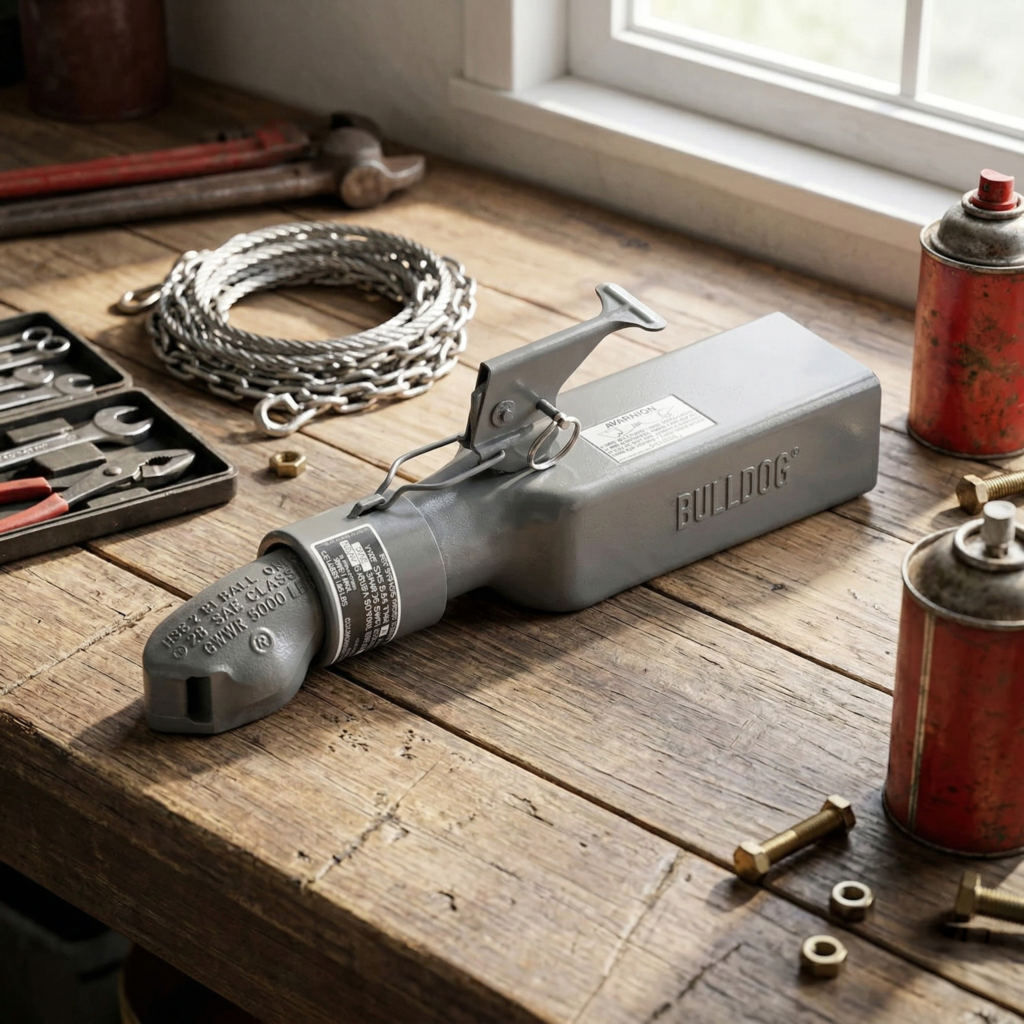
1. Straight-Tongue Couplers
The most common type for DIYers and casual towers. These are designed to bolt or weld onto a single, straight metal beam (the tongue) extending from the trailer.
- Best For: Small utility trailers, jet ski trailers, and light boat trailers.
- Mounting: Bolted or welded to a square or round straight tube.
- Pros: Inexpensive, easy to replace, and simple to operate.
- Cons: Lower weight capacity and less structural rigidity for heavy loads.
2. A-Frame Couplers
Named for their triangular shape, these couplers are designed to fit onto trailers where the frame rails meet at a point. They are significantly more robust than straight-tongue models.
- Best For: RVs, campers, and medium-duty utility trailers.
- Mounting: Welded or bolted onto the “A” shape of the trailer frame.
- Pros: High stability and better weight distribution across the trailer frame.
- Cons: Permanent mounting (if welded) and requires a specific trailer frame style.
3. Adjustable Channel Couplers
If you have a “fleet” of trucks with different ride heights, this is your best friend. The coupler itself is mounted to a vertical channel with several holes, allowing you to move the coupler up or down.
- Best For: Commercial trailers, construction equipment, and users with multiple tow vehicles.
- Pros: Ensures the trailer remains level regardless of the truck’s height.
- Cons: Heavier and more expensive than fixed couplers.
4. Gooseneck & Fifth-Wheel Couplers
For the heavy hitters. These don’t attach to a bumper hitch; instead, they connect to a ball or plate mounted in the bed of a pickup truck, directly over the rear axle.
- Gooseneck: Uses a ball hitch in the truck bed. Common for livestock and industrial flatbeds.
- Fifth-Wheel: Uses a large horseshoe-shaped plate (similar to a semi-truck). Primarily used for large luxury RVs.
- Pros: Massive weight capacity (often 20,000+ lbs) and a much tighter turning radius.
Quick Reference: Ball Sizes & Weight Ratings
A coupler only works if it matches the hitch ball size on your truck. Never “make it fit”, a 2″ coupler on a 1-7/8″ ball will eventually pop off, likely at highway speeds.
| Ball Size | Typical Weight Capacity | Common Use Case |
| 1-7/8″ | Up to 2,000–3,500 lbs | Light utility, jet skis |
| 2″ | 3,500–8,000 lbs | Most standard trailers/boats |
| 2-5/16″ | 10,000–30,000 lbs | Heavy equipment, large RVs |
3 Tips for a Safer Tow
- Check the Latch: Ensure the locking trigger or “Posi-Lock” handle is fully engaged and pinned before moving.
- Match the Ratings: Your towing system is only as strong as its weakest link. If your hitch is rated for 10,000 lbs but your coupler is only rated for 5,000 lbs, your limit is 5,000 lbs.
- Maintenance: Grease the inside of the coupler socket occasionally to prevent friction wear and rust.
What kind of trailer are you planning to haul? Knowing your “Gross Trailer Weight” (GTW) is the first step in picking the right hardware!