
If you’ve ever looked at the metal plate on the side of a trailer, you’ve seen a alphabet soup of acronyms: GVWR, GAWR, and GTW. Understanding these is the difference between a smooth trip and a highway disaster.
1. Decoding the Acronyms
Before we do the math, we need to know what the numbers represent:
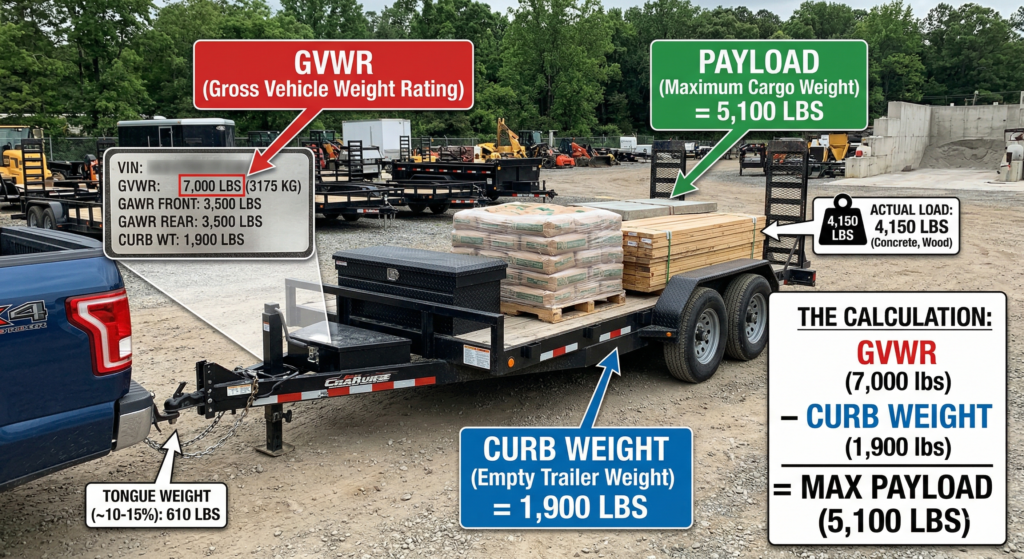
- GVWR (Gross Vehicle Weight Rating): This is the most important number. It is the maximum total weight your trailer is rated to carry safely, including its own weight.
- Curb Weight (or UVW – Unloaded Vehicle Weight): This is what the trailer weighs when it is completely empty.
- Payload Capacity: This is the actual weight of the “stuff” (cargo, gear, water, fuel) you can put inside or on the trailer.
- GAWR (Gross Axle Weight Rating): The maximum weight a single axle can handle. If you have a dual-axle trailer, the total GVWR is usually the sum of these (though not always).
- Tongue Weight: The amount of the trailer’s weight that presses down on the hitch of your truck. This should typically be 10-15% of your total loaded weight.
2. The Magic Formula
Calculating your load limit is actually quite simple. You take the total weight the trailer can handle and subtract the weight of the trailer itself.
Payload Capacity = GVWR – Curb Weight
Example:
- Your trailer’s GVWR is 7,000 lbs.
- The trailer’s Curb Weight (empty) is 2,200 lbs.
- 7,000 – 2,200 = 4,800 lbs.
In this scenario, you can load exactly 4,800 lbs of cargo. Not a pound more!
3. Don’t Forget the “Invisible” Weight
When calculating your payload, many people forget to account for the “extras.” If you add these to your trailer, they count against your payload:
- Spare tires and mounting brackets.
- Toolboxes and the tools inside them.
- Full water or fuel tanks (Water weighs about 8.3 lbs per gallon!).
- Heavy-duty tie-down chains or ramps.
4. The “80% Rule” for Longevity
While your trailer might be rated for a certain weight, seasoned towers often stick to the 80% rule. This means trying to keep your total loaded weight (GTW) at about 80% of your trailer’s GVWR. This leaves a safety margin for steep hills, sudden braking, and windy days, while also reducing wear and tear on your tires and suspension.
[Image showing trailer weight distribution and tongue weight effects]
5. Safety Check: Weight Distribution
Even if you are under your GVWR, how you load the trailer matters just as much as how much you load.
- Too much weight in the back: Causes the trailer to “fishtail” or sway dangerously.
- Too much weight in the front: Puts excessive stress on your tow vehicle’s rear suspension and brakes.
- The Golden Rule: Aim for 60% of the cargo weight in the front half of the trailer (closest to the truck) to maintain that 10-15% tongue weight.
Summary Checklist
- Find your GVWR on the trailer’s VIN sticker.
- Find your Curb Weight (check your manual or take the empty trailer to a truck scale).
- Subtract Curb Weight from GVWR to get your Payload.
- Distribute the load with 60% in the front.
- Double-check your tires! Ensure they are inflated to the “Cold PSI” listed on the sidewall to handle the max load.
Happy hauling!