
When you are looking to buy or rent a trailer, one of the biggest decisions you will face comes down to a simple count of the wheels. Choosing between a single axle and a dual axle trailer shapes your entire towing experience, from how much gear you can pack to how the trailer behaves when you hit highway speeds.
Single axle trailers feature just one axle and two wheels, making them the go-to choice for lighter, everyday hauling. Because they are lightweight, they are incredibly easy to maneuver. If you need to jockey the trailer into a tight corner of your garage or shift it around your yard by hand, you can usually do it without breaking a sweat. They are also much gentler on your wallet, both at the initial purchase and over time, since you only have two tires and one set of brakes and bearings to maintain. However, this simplicity comes with trade-offs. Single axle trailers bounce around more on rough roads, and they are prone to swaying if you get hit by a sudden gust of wind. Plus, if you blow a tire at sixty miles per hour, managing the trailer becomes an immediate, white-knuckle emergency.
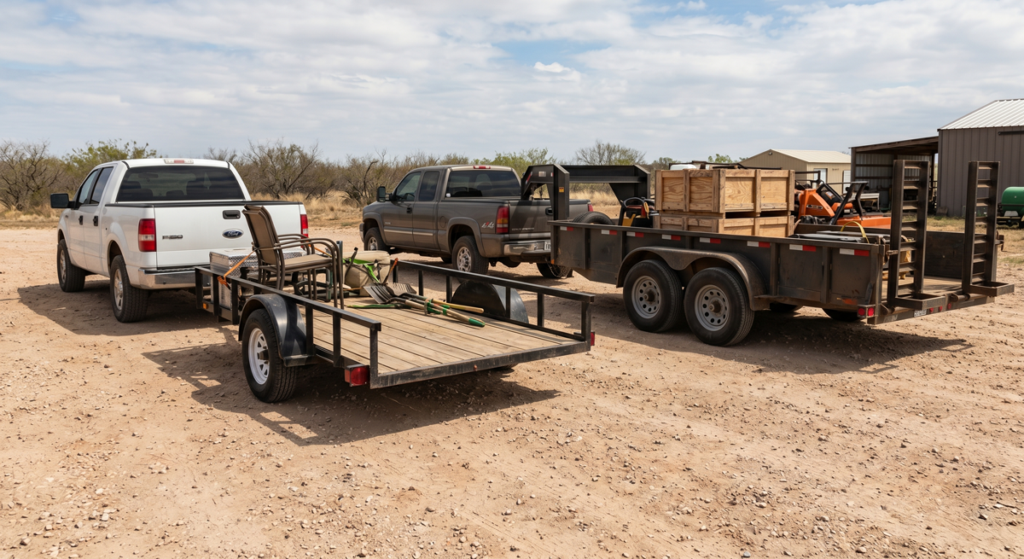
On the flip side, dual axle trailers, often called tandem axles, give you four wheels on the ground. This setup is built for serious heavy lifting and long-distance travel. The extra axle distributes the weight much better, giving you a remarkably smooth ride and vastly superior stability on the highway. When a big rig passes you, a dual axle trailer stays planted rather than getting sucked into the slipstream. Safety is another massive benefit here, as a flat tire on one side doesn’t mean instant disaster because the remaining wheel can support the load until you safely pull over. The downside to all this stability is cost and convenience. Dual axle trailers are more expensive to buy, require double the maintenance on tires and brakes, and eat into your truck’s fuel economy. They are also nearly impossible to budge by hand, so you will have to be precise with your truck whenever you are parking.
Deciding between the two really comes down to your typical weekend or workday. If you are just moving a lawnmower, some furniture, or a couple of dirt bikes around town, the single axle will save you money and hassle. But if you are hauling heavy construction materials, large boats, or planning cross-country road trips, the stability and safety of a dual axle are well worth the extra investment.