
Loading a trailer seems like it should be pretty straightforward, like a giant game of Tetris where you just fit everything in until the space is full. But if you have ever seen a truck on the highway swaying wildly back and forth while pulling a trailer, you know there is actually a lot of safety and physics involved. Shifting weight can completely ruin your drive and even cause a dangerous accident, so knowing how to pack it the right way is a huge deal before you ever hit the road.
The most important rule to remember is the sixty-forty split. You want about sixty percent of the total weight of your cargo to be loaded in the front half of the trailer, which is the side closest to your truck or SUV. The remaining forty percent goes toward the back. Putting more weight in the front keeps the trailer stable and pushes down on the hitch just enough to keep it attached firmly. If you put too much weight in the back, the trailer will start to lift up on the back of your vehicle, and that is exactly what causes that terrifying fishtailing or swaying when you start driving fast.
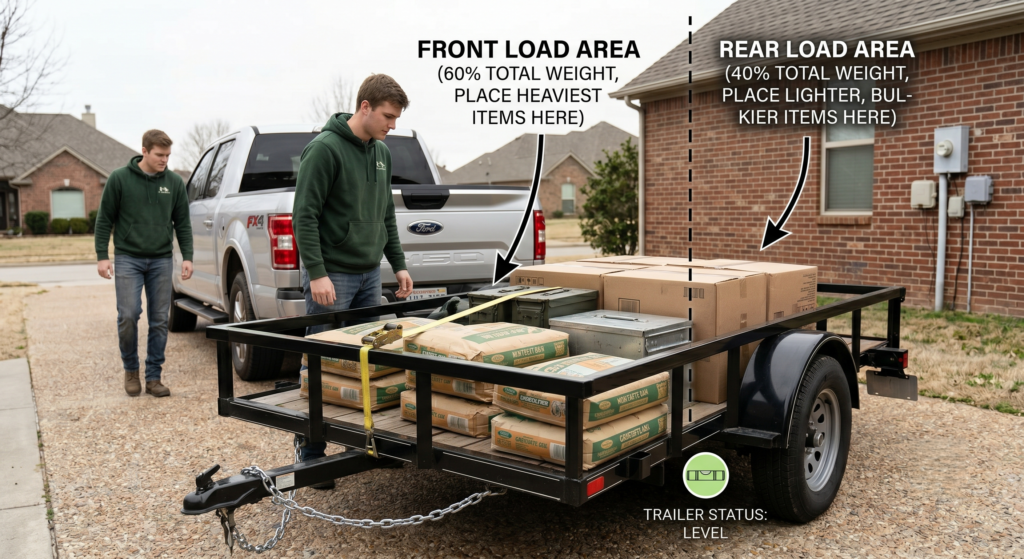
Besides putting the bulk of the weight toward the front, you also have to think about side-to-side balance and the center of gravity. Everything needs to be centered left-to-right so the trailer doesn’t lean to one side, which can cause you to lose control during sharp turns or lane changes. You also want to put your heaviest items on the floor of the trailer and the lighter stuff on top. Keeping the heavy items low to the ground stops the trailer from becoming top-heavy and tipping over when you hit a bad bump or get hit by a strong gust of wind.
Once you have everything positioned correctly, you can’t just leave it there and hope for the best. Even heavy objects can slide around when you slam on the brakes or go around a curve. Shifting weight mid-drive completely ruins your careful planning, so you need to use high-quality ratchet straps or tie-downs to secure everything to the trailer frame. A good rule of thumb is to give the cargo a hard shake after tightening the straps. If it moves even a little bit, it isn’t secure enough and needs to be tightened down more.
Before you actually hit the highway, take a step back and look at how the whole setup sits. Your truck and trailer should look relatively flat and level with the ground. If the back of your truck is sagging completely down, you have too much weight in the front. If the front of your truck is pointing up toward the sky, you have a major issue that will make steering and braking really difficult. Double-check your tire pressure on both vehicles, and take a quick drive around the block to make sure everything feels solid before you go on your actual trip.